
100 days: what the EU JCA means for your evidence plan
If your drug is heading for approval in Europe, a set of questions you did not choose may soon land on your desk.
For a standard assessment, you will have 100 days to answer them.
This is the EU Joint Clinical Assessment. Here is how it works, and what it changes about when you need to start planning your evidence.
The pivotal trial is no longer the only thing to think about. You also need to know whether your wider evidence package can answer the comparative questions that health technology assessment bodies across Europe are likely to ask.
One assessment, 27 countries
The EU Health Technology Assessment Regulation has applied since 12 January 2025. New cancer medicines and advanced therapy medicinal products came first. Orphan medicines enter the process from 13 January 2028, followed by all other new medicines within scope from 13 January 2030.[1,2]
A Joint Clinical Assessment, or JCA, is built around one main question: how does a medicine compare with the treatments already available?
The report looks at the effects on health outcomes, the strengths and limitations of the evidence, and the uncertainty around the results.
The JCA does not decide price, reimbursement or the overall value of a medicine. Those decisions remain with each Member State.
National authorities must, however, give due consideration to the published JCA report and use it within their own assessment processes.[1,2]
The result is one shared clinical report for HTA bodies across Europe. Get the evidence right, and you have the chance to start national assessments from a stronger position.
The clock starts earlier than you think
The JCA and the European Medicines Agency review run in parallel. The JCA does not wait for regulatory approval.
When a marketing authorisation application is submitted, information is shared with the HTA secretariat. The JCA subgroup then appoints an assessor and a co-assessor from different Member States.
The assessors then prepare a proposed assessment scope. Member States, patients and clinical experts all have a say.
The final scope is normally sent to the developer shortly after the Committee for Medicinal Products for Human Use issues its list of questions.
The developer then has 100 days from the European Commission’s request to submit the JCA dossier. The period falls to 60 days in accelerated procedures and for some variations. The dossier must also be submitted at least 45 days before the expected regulatory opinion.[2]
What must be ready
The dossier must answer every research question in the final scope with complete and current evidence.
This includes the clinical and safety evidence for the medicine, the evidence used to define relevant comparators, and the analyses used to estimate relative effects.
Where several studies contribute to a question, the evidence must be found and selected through a rigorous systematic review. The dossier must explain which studies were included, which were excluded and how the evidence was combined.[8,9]
If a direct comparison is available, it should be presented.
If no suitable head to head trial exists, the dossier may need an indirect treatment comparison. The chosen method, its assumptions, its limitations and the remaining uncertainty must be reported clearly.
A result on its own is not enough. Assessors need to see where it came from, what assumptions sit behind it and how much confidence they can place in it.
You do not choose the questions
The assessment scope is expressed through PICO questions:
-
Population: which patients are being assessed?
-
Intervention: which medicine is being assessed?
-
Comparator: what would those patients otherwise receive?
-
Outcome: which benefits and harms matter?
Member States contribute their needs to the scope. Since treatment practice differs across Europe, one medicine may need to be compared with several standards of care, in several patient groups and across several outcomes.
The developer can request a meeting to receive an explanation of the scope. However, the final set of questions is defined through the JCA process, not selected by the developer.[2]
The questions multiply quickly.
In a study using a hypothetical first line lung cancer medicine, six national HTA bodies produced 10 PICO combinations. Applying 17 outcomes to each PICO created 170 outcome questions.[5]
The exact burden will vary by medicine. The planning lesson will not. Modelling plausible JCA scopes before the final questions arrive is smart preparation.
What this changes for your evidence plan
1. Indirect comparisons move centre stage
A pivotal trial almost certainly cannot directly compare a medicine with every relevant European treatment.
The trial may use placebo when active treatments are used in practice. Standards of care may differ between countries. A new competitor may launch after the pivotal trial begins. In oncology and rare disease, the pivotal evidence may come from a single arm study.
Indirect treatment comparisons use evidence across studies to estimate how treatments may compare when a direct trial is unavailable.
Earlier EUnetHTA assessments show how central this evidence can become. Among 23 pharmaceutical assessments, 12 included an indirect comparison. Those 12 assessments required 64 treatment comparisons. Direct evidence covered 17%. Indirect evidence covered 39%. The remaining 44% were considered unfeasible and no comparison was submitted.[3]
One EUnetHTA assessment included two populations, eight comparators and 12 outcomes. If evidence had been available for every requested comparison, it could have required 96 separate analyses.[4]
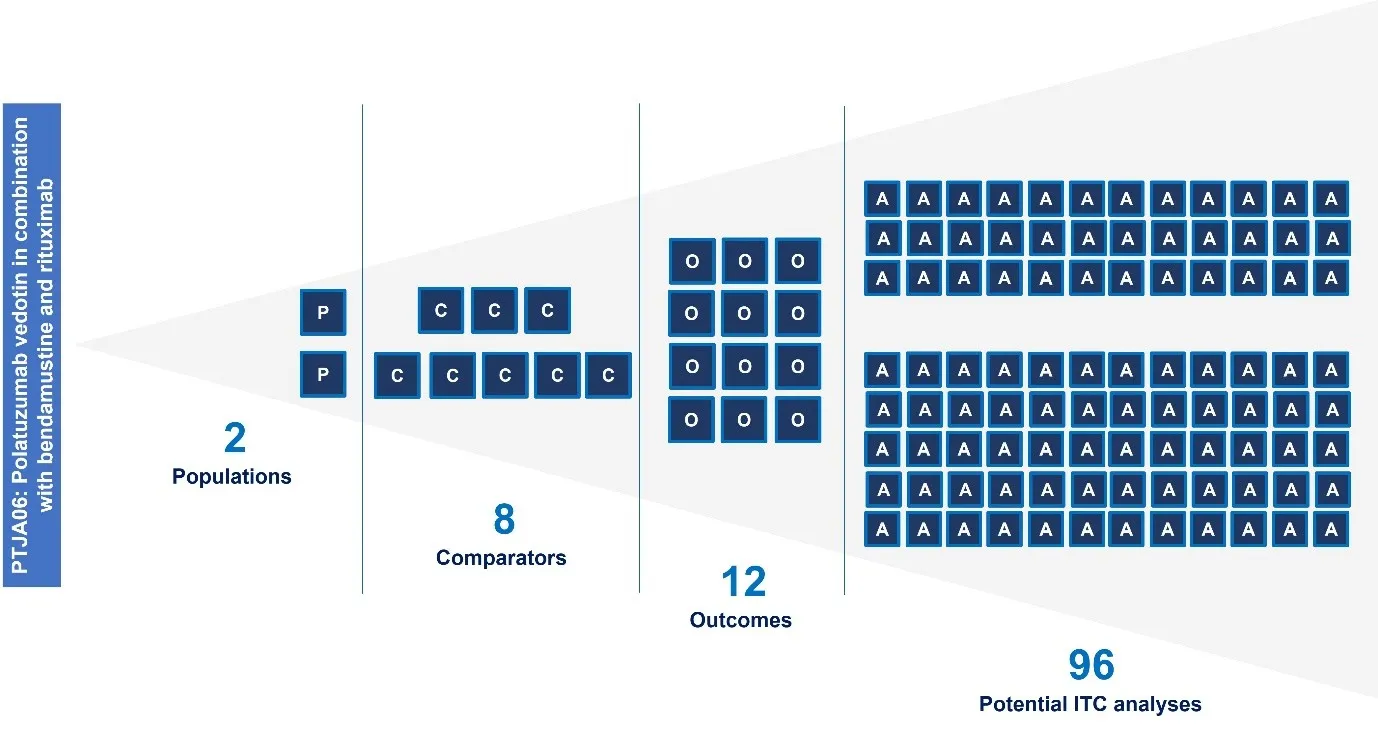
100 days. 96 separate analyses. Let that sink in.
These examples came from the EUnetHTA pilot period, not the live JCA process. They will not describe every dossier. But they show why indirect comparisons are moving from the supporting appendix to the centre of the evidence package.
2. The need for speed
The 100 day submission period is a delivery window. Most of what fills it is evidence synthesis.
For every question in the scope, someone has to establish which comparator trials exist, what outcomes they reported, whether their populations can be reconciled with yours, and whether the treatments connect through a common comparator. Only then does it become clear which analysis is possible, or whether one is possible at all.
That work sits upstream of every estimate in the dossier.
It also cannot be done casually. EU guidance requires the evidence to be found and selected through a systematic review, with a clear account of which studies were included, which were excluded and how the evidence was combined. It requires the choice of method to be justified, the analytical choices to be prespecified and sensitivity analyses to be presented.[8,9]
So this is not a matter of pulling together a few familiar trials. Each comparator named by Member States needs its own defensible evidence base, and that requirement multiplies across every population and outcome in the scope.
Doing this quickly is difficult. Doing it quickly and to the standard the JCA expects is harder.
3. Your data set the ceiling
No analytical method, however sophisticated, can repair missing comparator studies, incompatible outcome definitions or important patient characteristics that were never collected.
In the EUnetHTA review, 52 criticisms of submitted indirect comparisons were identified. More than one third concerned the underlying data. Differences between study populations and trials were the largest source of difficulty. Missing subgroup data, small samples and unavailable information on important patient characteristics also limited what the analyses could support.[3]
A separate review of oncology assessments in England, France, Germany, Italy and Spain reached a similar conclusion. The most common criticisms concerned differences between studies, unclear or missing data and the statistical methods used.[7]
The external evidence sets a ceiling of its own. Establishing which comparator trials exist, and whether their outcomes can be aligned with yours, is a question for a rigorous systematic review rather than for the analysis that follows it.
4. No method fits every evidence gap
There is no single method that works for every situation.
When trials share a suitable common comparator, a standard indirect comparison (the Bucher method) or network meta analysis may be possible.
When trial populations differ in ways that change the treatment effect, methods such as a matching adjusted indirect comparison, simulated treatment comparison, or multilevel network meta regression may be considered.
EU guidance places strong emphasis on whether studies are similar enough to combine and whether the evidence network preserves randomisation through a common comparator. It also requires clear justification of the chosen method, prespecified analytical choices and sensitivity analyses.[8,9]
The guidance is especially cautious when the evidence network is disconnected or relies on single arm studies. In that setting, the analysis needs to account for every factor that affects the outcome as well as every factor that changes the treatment effect. Some of those factors may be unknown or unmeasured.[8-10]
For a matching adjusted comparison, the overlap between populations, the distribution of weights and the effective sample size are important. They show how much of the original trial still informs the result after adjustment.[9-11]
The reports from the EUnetHTA pilots also rarely gave a simple pass or fail. Of the 25 comparisons based on indirect evidence, the review classified 24 as unclear and one as appropriate. None was explicitly classed as unsuitable.
Even so, the results were included in final assessment reports to be used as part of the evidence for national decision-making, underscoring the value of data derived from indirect evidence.[3]
That is why clear reporting matters. Decision makers need to understand what the analysis can answer, which assumptions it relies on and where uncertainty remains.
5. One report, many national decisions
The JCA creates one clinical report for Europe, but Member States still draw their own conclusions.
The relevance of individual comparators and populations will vary by country. National methods and attitudes to indirect evidence may also differ.
A review of oncology assessments in five European countries found an overall acceptance rate for indirect comparisons of 30%. Acceptance was highest in England at 47%. In France, none of the submitted comparisons were accepted. Germany accepted seven of 12 Bucher indirect comparisons but none of the three matching adjusted indirect comparisons it received.[7]
Reviews of European and national guidance have already identified differences in how countries approach disconnected evidence networks and methods that adjust for population differences.[6]
Your evidence plan therefore needs to prepare for the JCA and the national decisions that follow it. A sound EU submission is the foundation, not the final step in market access.
Planning for the JCA
A good JCA evidence plan begins with the likely decision questions, not a shopping list of analyses.
Map the questions.
Identify the likely populations, comparators and outcomes across the target European markets. This creates a working set of possible PICOs.
Map the internal evidence.
Record what the pivotal trial answers directly, which subgroup data are available and which patient characteristics were measured consistently.
Build the external evidence landscape.
A systematic review will identify comparator trials, outcome definitions, follow up times and possible links between treatments.
Test feasibility.
Identify which questions can be answered by direct evidence, which need an indirect comparison and which cannot be answered reliably with the evidence available.
Prioritise the gaps that can still be changed.
This may affect trial data collection, planned subgroup analyses, access to patient level data, outcome harmonisation or evidence generation after the pivotal study.
Prepare for delivery.
Prespecify the analyses and reporting so they can be updated efficiently when the final PICO scope arrives.
For eligible products, an EU Joint Scientific Consultation can provide advice on evidence needs while clinical studies are still being planned. It is a useful route to consider, but it does not replace a living evidence plan inside the company.[12]
Take home
-
The EU JCA runs alongside the European Medicines Agency review, so evidence planning belongs earlier than most teams assume
-
The final PICO scope may contain several populations, comparators and outcomes. This means tens of questions. And direct trial evidence will almost certainly not answer them all.
-
Indirect treatment comparisons will be central to many JCA dossiers.
-
The 100 day deadline creates a need for speed and rigour.
-
The available data will determine which questions can be answered credibly.
-
A JCA ready evidence plan should connect likely PICO questions, internal trial evidence, the external evidence landscape and the national decisions that follow.
This is the kind of connected planning Evidax supports. We bring the internal evidence and published landscape together, identify the gaps that matter and generate the comparative evidence needed to address them.
Start by finding out where your evidence falls short. Everything else follows from that.
References
-
European Parliament and Council. Regulation (EU) 2021/2282 of 15 December 2021 on health technology assessment and amending Directive 2011/24/EU. Official Journal of the European Union. 2021;L458:1-32. https://eur-lex.europa.eu/eli/reg/2021/2282/oj
-
European Commission. Joint Clinical Assessment for Medicinal Products. January 2025. https://health.ec.europa.eu/publications/factsheet-joint-clinical-assessment-medicinal-products-january-2025_en
-
van Beekhuizen S, Che M, Monfort L, et al. Indirect treatment comparisons in EUnetHTA relative effectiveness assessments: learnings and recommendations for the implementation of EU joint clinical assessments. PharmacoEconomics Open. 2025;9:597-609. https://doi.org/10.1007/s41669-025-00575-1
-
van Beekhuizen S, Che M, Monfort L, et al. Supplementary material to: Indirect treatment comparisons in EUnetHTA relative effectiveness assessments. 2025. https://doi.org/10.1007/s41669-025-00575-1
-
van Engen A, Kruger R, Ryan J, Wagner P. HTA97: Impact of additive PICOs in a European joint health technology assessment: a hypothetical case study in lung cancer. Value in Health. 2022;25(Suppl):S315. https://doi.org/10.1016/j.jval.2022.09.1556
-
Laughlin W, Bretton D, Olid Gonzalez A, Bending MW. HTA147: Similarities and differences between the HTA methods for indirect comparisons in the EU Joint Clinical Assessment and national assessments by Member States. Value in Health. 2023;26(Suppl):S347. https://doi.org/10.1016/j.jval.2023.09.1831
-
Macabeo B, Rotrou T, Millier A, François C, Laramée P. The acceptance of indirect treatment comparison methods in oncology by health technology assessment agencies in England, France, Germany, Italy, and Spain. PharmacoEconomics Open. 2024;8:5-18. https://doi.org/10.1007/s41669-023-00455-6
-
Member State Coordination Group on Health Technology Assessment. Methodological Guideline for Quantitative Evidence Synthesis: Direct and Indirect Comparisons. 8 March 2024. https://health.ec.europa.eu/publications/methodological-guideline-quantitative-evidence-synthesis-direct-and-indirect-comparisons_en
-
Member State Coordination Group on Health Technology Assessment. Practical Guideline for Quantitative Evidence Synthesis: Direct and Indirect Comparisons. 8 March 2024. https://health.ec.europa.eu/publications/practical-guideline-quantitative-evidence-synthesis-direct-and-indirect-comparisons_en
-
Phillippo DM, Ades AE, Dias S, Palmer S, Abrams KR, Welton NJ. NICE DSU Technical Support Document 18: Methods for Population Adjusted Indirect Comparisons in Submissions to NICE. NICE Decision Support Unit; 2016. https://www.sheffield.ac.uk/nice-dsu/tsds/population-adjusted
-
Welton NJ, Phillippo DM, Owen R, et al. CHTE2020 Sources and Synthesis of Evidence: Update to Evidence Synthesis Methods. NICE Decision Support Unit; 2020. https://www.sheffield.ac.uk/nice-dsu/methods-development
-
European Commission. Joint Scientific Consultations. Accessed 30 July 2026. https://health.ec.europa.eu/health-technology-assessment/implementation-regulation-health-technology-assessment/joint-scientific-consultations_en